Christmas Crafts for Preschoolers: Everything You Need to Know
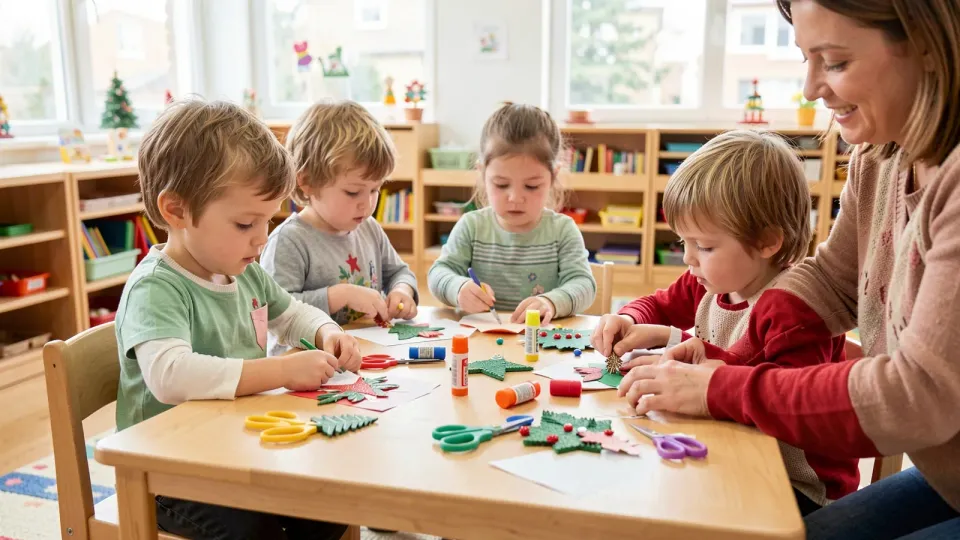
Start with the afternoon you actually have
Christmas crafts for preschoolers work best when they fit the day you are already living, not a catalog of twenty projects. In our house that usually means one short sitting after a snack, a table I can wipe, and a project that can stop halfway if someone needs a hug or a nap. The aim is a thing the child helped make, not a display piece an adult finished later and signed with the child's name.
Preschoolers, roughly ages three to five, are not a single skill level. The CDC's developmental milestone pages are a reminder that fine motor control, attention, and the habit of putting objects in the mouth all change across those years, and they change at different speeds. A younger preschooler may still mouth a bead or a button. An older one may use child scissors with help, then wander off after ten minutes. Plan for the child in front of you, and for any younger sibling who will wander over. The official milestone hub is here: CDC developmental milestones.
Safety is part of the craft, not a footnote. The U.S. Consumer Product Safety Commission's Art and Craft Safety Guide is the document we keep coming back to: use materials meant for children, look for the “Conforms to ASTM D 4236” statement, keep food and drinks off the art table, wash hands after, and let adults handle dusty powders, solvents, and anything with a cautionary label.
Materials that belong on a preschool table
A Christmas craft stash does not need a special shop. wrapping-paper scraps, brown paper bags, old greeting cards, cardboard from a delivery box, child-safe glue sticks, chunky crayons, washable paint, stickers, and yarn offcuts will cover most of December. What you leave out matters as much as what you buy.
| Material or tool | Useful for | A safer way to use it | Leave it out, or keep it for adults, when |
|---|---|---|---|
| Glue sticks and white washable school glue | Collage, paper trees, card fronts | Small amounts, lids back on, hands washed after | The child is still chewing on glue caps, or you only have a solvent-based cement |
| Child scissors, blunt tip | Cutting strips, fringing, simple shapes | Sit with the child, hold the paper if needed, put scissors away after | A toddler is sharing the table, or the only scissors in the house are sharp adult shears |
| Washable paint and big brushes | Trees, night skies, gift wrap | Smock, covered table, one or two colors at a time | You were about to use leftover wall paint, spray cans, or anything unlabeled |
| Stickers, paper scraps, old cards | Decorating, collage, “stained glass” windows | Offer a small pile, not a full shoebox | The decorations include tiny sequins, loose beads, or plastic gems a young preschooler can swallow |
| Low-temperature glue gun | Attaching a hanging loop, at the end | Adult only, even if the label says “low temp” | There are children close enough to grab the tip; high-temperature guns stay in the toolbox |
| Natural bits: pine, cinnamon sticks, dried orange slices | Smelling, gluing to a card or a wreath base | Large pieces, fully dried, used with supervision | Anything small, brittle, or tempting to eat is within reach of a mouth-age child |
| Glitter and loose flocking | Honestly, very little | If you must, use glitter glue in a closed bottle | Loose glitter on a table where people snack; powders the child can inhale |
The Commission is blunt about donated and old supplies. Unlabeled bottles, leftover adult oils, and anything with a warning label are not a bargain for a preschool table. If you cannot name what is in the jar, it does not go out.
A short menu of Christmas projects that can stop halfway
Paper Christmas trees: fold a green sheet, or stack triangles from leftover wrapping paper, and let the child stick on “ornaments” cut from card scraps. An adult can cut the triangles in advance. The child's job is choosing and placing.
Cards for people they actually know: a folded piece of card, a painted hand or a stamped shape, and one dictation line you write for them (“To Nana, love …”). This is still crafts with preschoolers, not handwriting practice. If they want to scribble the name themselves, that is the card.
A simple wreath: a cardboard ring from a delivery box, torn paper, or scrunched tissue. Yarn can be wrapped around the ring if someone helps start it. Hang it with a ribbon an adult ties.
Window stars or simple paper chains: strips of used wrapping paper, stapled or glued into loops. The staple job is an adult's. The looping and choosing is the child's. This is a good project for a mixed-age afternoon, because it can absorb five minutes or thirty.
Salt dough and candy-like decorations look festive and cause trouble. Anything that looks edible will be tested. If you want an ornament, use card, felt sheets cut by an adult, or a large, already-dry item with a hole punched by you. Keep craft and snack at different times, on different surfaces, which is also what the CPSC guide asks for.
One project per sitting is plenty. If the child wants to make “another one” for a neighbor, that is a success, not a reason to open a harder kit.
How we set the table so the day stays kind
Cover the table with paper you can throw away, or work on a washable mat. Put only today's materials out. A tray with the pieces for one card is calmer than a crate of mixed supplies. Sit down with the child. Supervision here is not hovering from the sink; it is being close enough to stop a bead, a pair of scissors, or a taste test.
Expect a short attention span and call the project finished while it is still pleasant. Write the child's name and the year on the back if they want, then move the wet work somewhere safe to dry. Wash hands and wipe the table before food comes back out. Store leftover supplies up high, closed.
If you are making with a group, give each child their own small set rather than a communal bowl of tiny decorations. That single habit prevents both grabbing and choking risks.
A checklist for a calmer Christmas craft hour
- The project can be finished, or honestly paused, in one short sitting
- Every supply is meant for children and, where relevant, marked as conforming to ASTM D 4236
- There are no loose beads, magnets, button batteries, or coin-sized decorations on the table
- Scissors, glue, and any heat tools have an adult plan
- Food and drinks are off the art table
- Younger siblings cannot wander in and mouth the pieces
- You have a place for wet work to dry, and a way to get hands and table clean before the next snack
Questions parents ask once the glue is out
What if my preschooler only scribbles and will not “make a tree”?
That still counts. A scribbled card with a name on the back is a Christmas craft. If a more representational project matters to you, do the adult cutting in advance and let the child decorate a shape that already exists. The making is the point, not the resemblance.
Are kits from the shop better than scrap paper?
Sometimes a kit is a convenience, especially if it includes child-safe glue and large pieces. It is not automatically safer. Read the age label, tip out anything tiny if you have a younger child in the room, and skip kits that rely on a high-temperature glue gun or unmarked paints.
How do we keep crafts from taking over the house until New Year?
Give the work a landing place: one box, one string, or one window. Photograph the ones that will not keep, then let some of the paper go. A few pieces used as wrapping or as a card are a better end than a guilty pile on the dresser.
Can we use pine cones, nuts, and hard candy as decorations?
Large, clean pine cones can work with close supervision. Nuts, hard candy, and small natural bits are a poor choice on a preschool table, both because they look edible and because small, hard objects are a choking risk. Keep real food for eating, at a different time.