Thanksgiving Crafts for Preschoolers: Everything You Need to Know
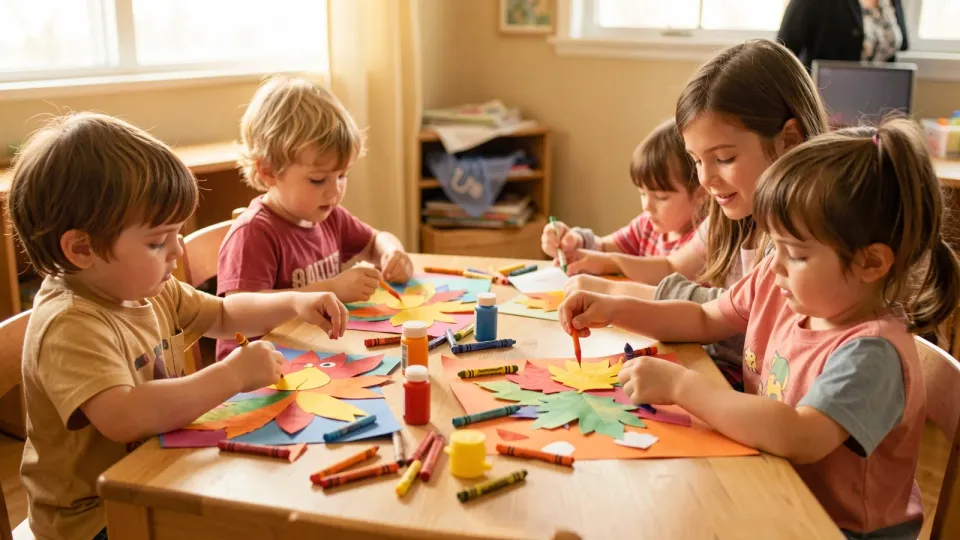
Give the child a job at the table, not a perfect turkey
Thanksgiving crafts for preschoolers go better when they belong to the day itself: a place card, a leaf rubbing, a short “I am glad for…” sheet, something to do while a dish is in the oven. The handprint turkey can still appear if a child wants it. It does not have to be the whole plan, and it does not have to look like a card from a shop.
This is a house with mixed ages and a busy kitchen, so the useful questions are practical. What can a three- or four-year-old make without a tray of small, edible-looking decorations? What can be finished before guests arrive? What can actually go on a table and then be taken off again for the meal? The CDC’s developmental milestone pages are a good official reminder that preschoolers vary widely in cutting, sitting still, and whether they still put objects in their mouths. Plan for the youngest hand that will reach the table.
Safety is the same as for any children’s art. The U.S. Consumer Product Safety Commission’s Art and Craft Safety Guide asks you to use child-safe, labeled materials (look for “Conforms to ASTM D 4236” where it applies), keep food and drinks out of the art area, wash hands after making, and keep solvents, sprays, dusty powders, and high-temperature glue guns away from young children. That last point matters on Thanksgiving, when the real oven and the real food are already competing for attention.
Crafts that can live near a meal, carefully
Harvest and gratitude crafts often borrow food: Indian corn, beans, seeds, popcorn kernels, whole spices. Those materials look like a snack and are a choking risk, especially for younger preschoolers and for visiting toddlers. They also break the simple rule that art and eating should not share a surface. Use paper, leaves, crayons, and large collage pieces instead, and keep the actual cooking ingredients in the kitchen.
| Craft | Where it fits in the day | What the child does | Supplies that belong | A caution |
|---|---|---|---|---|
| Place cards | Early in the day, or the day before | Scribble a mark, stick on a leaf-shaped paper, decide who sits where while you write the name | Card scraps, crayons, large stickers | Do not use nuts, candy, or popcorn as the decoration |
| Leaf rubbing or leaf print | After a short walk, if you have leaves | Hold the paper, rub a crayon on its side, choose which leaf is “theirs” | Paper, peeled crayons, leaves you know are clean enough to handle | Wash hands after; skip unknown berries and mushrooms; some children will try to taste a leaf |
| A gratitude sheet or paper chain | While a dish cooks | Dictate a few things you write down, or draw them; add loops to a chain | Paper strips, glue stick, a marker | Keep the chain away from candles and the cooktop |
| A “welcome” sign or door picture | Morning, with plenty of drying time if painted | Big-brush painting or collage on a cardboard box panel | Washable paint or paper scraps | Adult hangs it; keep chairs from becoming a ladder |
| Handprint or footprint bird, if the child wants it | Early, with washing-up already set out | Press a painted hand, then add legs or a beak with a crayon after it dries | Washable paint, paper, a sink or a bowl of water ready | Do this away from the food table, and never on a child who hates the feeling |
| A simple centerpiece they help arrange | Shortly before the meal | Choose two or three large items and a paper runner they decorated | A low tray, paper, a few large gathered leaves or a small pumpkin an adult carries | No candles a sleeve can catch, no small parts, no nuts in a bowl a toddler can reach |
A low centerpiece the child helped arrange is often a bigger success than a complicated character craft, because it is still there when people sit down. Keep it low enough to see over, and take any paper runner off if it will be in the way of dishes.
A calm way to make things in a busy kitchen
Set a craft tray in another room, or at the far end of the table, before the serious cooking starts. Preschoolers want to be near you. They do not need to be next to a hot tray. Give them the already-cut place cards and a cup of crayons, and come back to write names together. If the house is full of cousins, make a second identical tray rather than one communal bowl of decorations.
If you go out for leaves, stay on familiar ground and take only what you can identify as ordinary fallen leaves. Wash hands when you come in. Rubbings work with slightly damp leaves, but very wet ones tear and stain. This is a good project for children who do not like glue.
For gratitude work, keep the language ordinary. “What was a good thing this week?” is enough. Some preschoolers will say “pasta” or “the dog” and then be done. Write it down as they said it. A sheet like that, tucked under a plate or taped into a cupboard for the year, is more personal than a template with a cartoon pilgrim.
Cleanup has to be real, because food will come out. The CPSC guide’s insistence on washing hands and keeping food off the art table is not fussiness on this particular holiday. Wipe the table, put lids on, and only then set out dishes. Store leftover paint and scissors up high before guests arrive with younger children.
A checklist for a Thanksgiving afternoon
- The child has one real job: a card, a rubbing, a chain, or a place at the arranging tray
- Craft materials are paper, leaves, and child-safe colors, not beans, nuts, or candy
- The making happens away from the hot part of the kitchen
- Candles, small decorations, and button batteries are not part of the “centerpiece”
- Hands get washed, and the art table is cleared, before food is served
- Visiting toddlers cannot reach the supplies
- You have a plan for where the work goes after the meal, so it is not thrown away by accident
Questions that come up before guests arrive
Do we have to make a turkey craft?
No. A place card or a leaf rubbing is enough, and some children would rather draw a dog or a car and still call it their Thanksgiving picture. If a handprint turkey would please them, do it early, with washable paint and a sink ready.
How can a very young preschooler take part without a mess spreading?
Offer a single pre-cut card and one crayon, or a leaf under a taped-down sheet of paper for rubbing. Sit with them. A smaller choice usually works better than a table of options when the house is already stimulating.
Are corn kernels, beans, or seeds all right if I watch closely?
It is still a poor choice for a preschool table, especially with mixed ages. Hard, small foods are a choking hazard, they look like a snack, and they scatter. Paper “kernels” or drawn patterns get you the harvest look without the risk.
What do we do with the crafts after dinner?
Send place cards home with guests, if the children want that, or clip the gratitude sheets to the fridge for a week. Photograph the table before you clear it. You do not need to keep every paper, but it is worth not treating the work as rubbish in front of the child who just made it.